
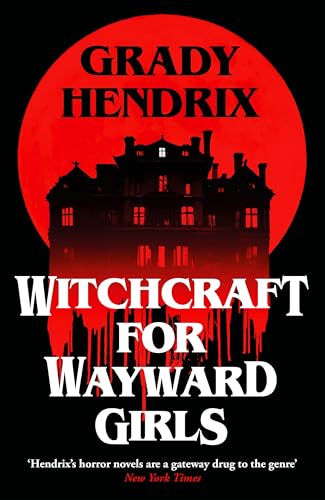
Witchcraft for Wayward Girls by Grady Hendrix
My rating: 4 of 5 stars
It is the 1970s, and getting pregnant out of wedlock is one of the worst things a woman can do. They are ostracized, considered loose and immoral, stupid girls who don’t know what’s best for them. Unfortunately 15 year old Fern has gotten pregnant herself. In order to avoid shame, her family sends her to Wellwood Home for Wayward Girls, to wait out her due date away from prying eyes. She’ll have the baby, give it up for adoption, and come home as if nothing had ever happened. But how could Fern forget her baby? The other girls she meets at the home? The book of witchcraft she used to gain even a modicum of control over her life?
Once again, Grady Hendrix has written a book that is able to take a dark/deep subject matter and keep its importance while making it entertaining to read. Thus, we can look at the topic with a certain amount of emotional distance. The characters are relatable, and each of the main characters Fern encounters on her journey are well fleshed out and unique. The setting, a large home retrofitted into a shared boarding house for pregnant women, is a somewhat isolated situation that adds a certain amount of suspense to the tale. The story takes a while to really get going, but once it does, it is a wild ride. Of course, it is worth having a think about the idea of this deeply female experience being written by a man.
We shall begin with Fern. Fern is a 15 year old who has gotten pregnant, and who’s boyfriend broke up with her as soon as he found out. The way he did so was very anger inducing. Many of the girls at the home have similar experiences with the people who got them pregnant, and the way the boys face little to no consequences is both infuriating and a mirror held up to reality. We experience this story from the third person point of view of Fern herself. She meets and grows close with some of the girls at the home, including Rose, Zinnia, and Holly. None of these names are their legal names. They don’t share any personal information with each other. Regardless, each of these girls has an interesting, somewhat tragic backstory. Part of the reason she becomes close with these girls in particular, despite not even much liking Rose, is because they are all her roommates at one point or another.
Their bond only deepens when Fern is given a book about witchcraft from the librarian that comes to them every two weeks, and they begin experimenting. I’m going to be honest with you, as much as I enjoyed this aspect of the story, I feel like the amount of witchcraft the girls take part in is less than I was hoping for, given that it was in the title of the book. They did what was necessary for the story, certainly, this is just a personal nitpick.
The setting of Wellwood Home for Wayward Girls is an interesting one for its physical location and layout, but also for the connection the people who reside in the home share. It is located in Florida, far enough away from the town nearby to keep the girls anonymous and out of people’s thoughts. This keeps the girls safe from scrutiny by outsiders of course, but it also isolates them. For the months they are in the home, the only world they know is the home. They socialise with the others, do chores, do their schooling, their religious studies (which is infuriating in and of itself here, as not all these girls are actually religious, but it is pushed upon them and used to shame them and instruct them on how to be better women/ wives/ mothers, in the future), eat individualised diets, depending on what they need for their pregnancies, and go to clinic to be examined. They watch reruns on TV, and they do listen to the radio, but otherwise, the outside world might as well not exist for them. Just as they don’t exist to the outside world.
Speaking of clinic, one of my least favourite characters in this book is the doctor that works at the home. He is absolutely awful. He takes care of the health of the girls, certainly, and I am sure he believes everything he does is for their better good, but he shames Fern so much, and nobody explains to any of the girls what to expect in their labours. As if they are too stupid to learn something that is imminently going to be extremely important for them, about their own bodies. Sex ed has improved to a degree from this (in Australia anyway), but we still have a long way to go, even now. Keeping them in the dark is unfair, but it is truly the way he speaks to Fern, and I assume the other girls in their clinic appointments, that is so unprofessional and unnecessary. Cruel.
Mrs. Wellwood is another character that I wasn’t too keen on. I’m sure you’ve figured out based on her name that she runs the home, that was originally run by her father. There were aspects of her that were sympathetic, in her past especially, and again, she genuinely believed she was doing her best by these girls. But she was a product of her time and upbringing, and also has many terrible moments.
Hagar and Miriam worked at the home, and they were interesting characters. They were relatively empathetic, they were caring, but they stayed out of it for the most part, because rocking the boat as a black woman in the South is a dangerous proposition. I wish we could have spent more time with them, as I feel they had a lot to give the story. They do sort of fit the trope of the spook. They know enough about the supernatural to be helpful combating it. They were positive characters I believe, but them fitting in that common trope for people of colour might be frustrating for some readers.
The setting of the house, as I said, has an emotional aspect as well, with the bond that the pregnant women share. They may never become close friends (especially with the anonymity that is enforced), but they understand what each other are going through. Boyfriends that left some of them, the blame and shame placed upon them, being shipped off from their families, who are being told they are elsewhere. Struggling with the emotional trauma of growing a human that you can’t become attached to as you have been essentially forced into giving them up, and the physical trauma of pregnancy. That is a lot for a person to go through, and one positive aspect of the girls living in a home together is that at least they don’t have to experience these things alone.
As I mentioned above, the story does take some time to get going. I feel in this case, that is fair and works in its favour. Before we can get to most exciting part of the story, we need to feel for the involved characters. So we spend time getting to know Fern. She needs time getting to know Rose, Zinnia, and Holly. We need to get settled into the Home and get to know how its ins and outs, and the people that work there. If we don’t care for the characters and understand how difficult and cruel their world is, we wouldn’t care about the journey they find themselves on.
I do want to briefly address the fact that this book is written by a man. Grady Hendrix is a fantastic author. He has a knack for writing horror stories that have a sense of humour and a very serious central theme. And he clearly feels a draw to the female experience. Many of his works revolve around women and girls, growing up, experiencing puberty, sexual assault, grief, pregnancy, invisibility in relationships and to the world. Very real issues that real women face. Grady Hendrix is a very popular author within the genre, and I have no problems with that, or his subject matter, but I do wonder if stories written by lesser known female authors with similar themes that they may have personally experienced are glossed over. This is not the fault of Hendrix, but it is worth pondering for our own reading habits. To his credit, he does address his draw to telling the story from Witchcraft for Wayward Girls in the afterword. He had a few women in his family who he recently found out had been to these homes in real life. We can’t help where our inspiration comes from.
Many people say that Witchcraft for Wayward Girls is Hendrix’s weakest book, and I can see that point of view for sure, but I still enjoyed it. I’ve not read everything he’s written yet, so I can’t really do a proper ranking of his works, but this one currently would probably be in the middle. It does seem to lack his trademark humour, but I don’t believe the story was weaker for that. If you enjoy a slow burn story, with real world precedent, a sad story that makes you sit and think and stew in negative emotions, with some witchcraft and serious consequences mixed in, then I think you’ll also enjoy this.
View all my reviews
 Rebecka O'Malley